Irregular Shaped metamorhosed Mudstone
Generally, Mudstone has relatively indistinct joints and generally exist in massive bedding or interbedding with other sedimentary bedrocks.
But, these samples are hardened and irregular, as if being joined together from pieces with bonding agents. One sample looks like conglomerate with same materials. These rock samples are from a gold mine at Siniawan near Bau near Kuching.
Imagine, millions of years ago this bed of sedimentary rock was intruded by hot lava below which also brought the gold ingredients to the surface. As the sedimentary rock experienced high temperature and pressure, the soft rock got baked, shrunk and cracked, forming thousands of micro-joints. Chemical solutions then seaped in and closed all the joints.
So, there it is, our fractured metamorphosed Mudstone near the surface as humans excavated down to look for gold.
Meta-Sandstone Aggregates?
The other day I passed by an ongoing bridge construction site at Sri Aman and saw these aggregates. I was wondering what types of aggregates this Contractor used. The stones look like Meta-sandstone. I had no one to ask at the site.
The nearest Quarry is somewhere along Sri Aman to Betong Road, which happens to be a Meta-sandstone site.
Meta-sandstone is a metamorphosed rock and often intruded by white quartz veins. The are just moderately good quality stones and required much tests to confirm whether they are according to the MS or BS Standard.
I would not know whether these aggregates are suitable for use in high strength prestressed concrete structures until comprehesive tests are done. Good quality Granite aggregates are generally recommended for the high strength concrete.
Failed Column (3)
Early last month when I was in Sarikei, I saw the contractor knocked down the front part of the shophouse, two floors above the walkway plus the column. The Owner chosed to use conventional piling for the failed corner column and then to build upwards again. I was told that three months was required for the repairing works.
Last week I saw them casting the first floor.
Probably, the micro-pile system is too expensive to be adopted as the local Contractor has no such drilling machine and skills. Concern of the structures above may fail during pile and foundation installation, might also refrain Owner/Contractor to use this faster method.
Failed Column (2)
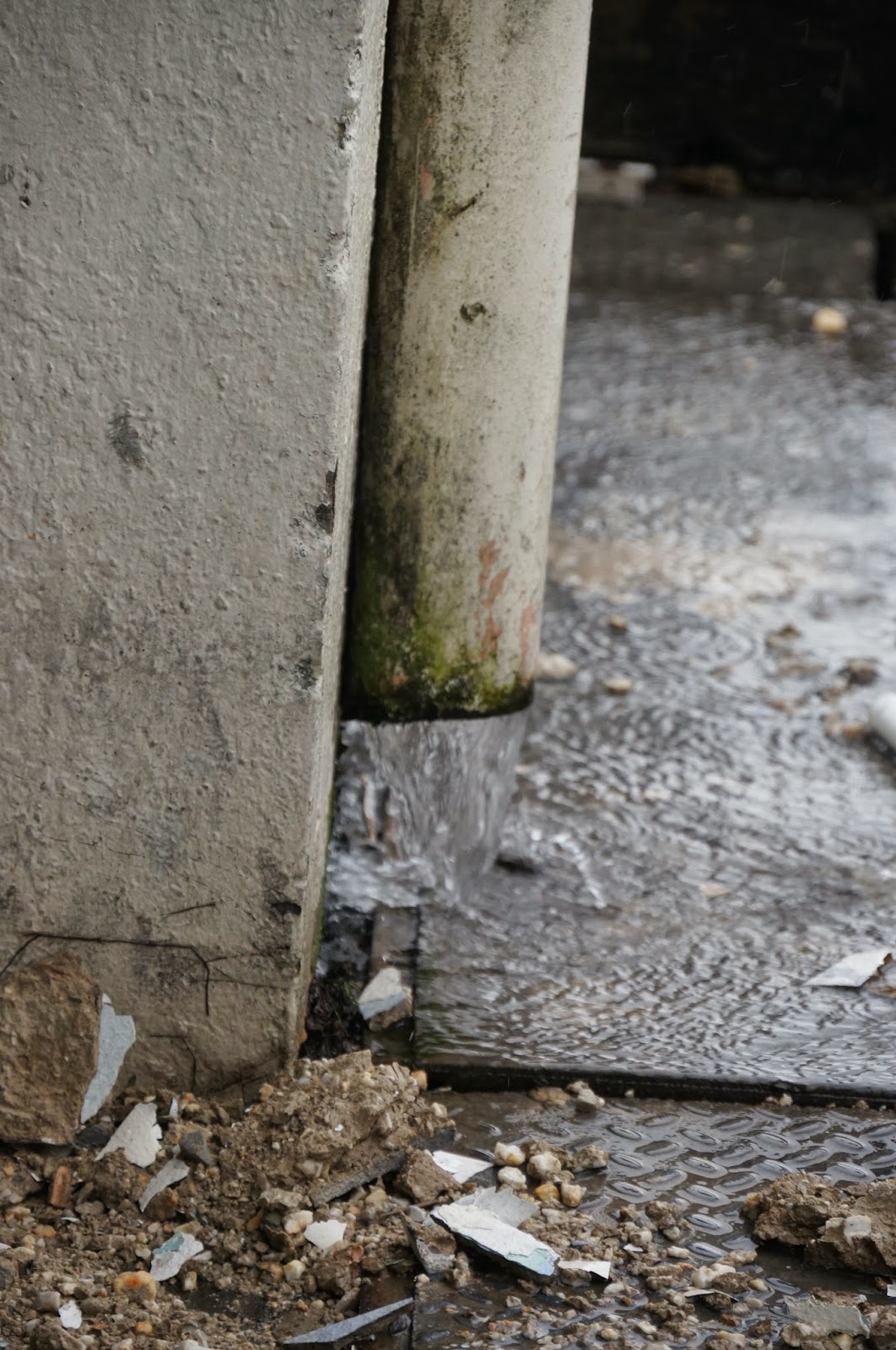
Since it failed during the raining night, then one of the reasons must be due to water. Somehow the water entered the foundation, either the soil becomes more soggy or the water erodes the foundation. Looking at the rainwater downpipe discharge, the rainwater did not enter the covered drain, some of it seeped through the floor crevices into the soil.
Then the cover was opened and observed, the drain was eroded with holes at the base, water had been consistently entering the soil instead of discharging to the big drain and into the river.
Then you see the big vehicles stopping just nearby due to traffic light, less than 2m away. When they moved, you could feel the building trembled.
If you have played clayey soil with the water, you will know the effect. When you pour a lot of water onto soft soil, some will seep in and come out somewhere, some will enter the soil structure and increase the moisture content, some will remain on the surface to be vaporised. But when you shake it with vibration, most of water will enter the soil structure, the soil will become so soft and may become liquefied.
After years of water entry and vibration, foundation gradually weakened and sank down. Based on the year of construction (during 1950s), the foundation was probably Bakau piles. The outer piles are the most affected, causing tilting towards outside.
As the walkway span is shorter than interior span (about 3m versus 6m), the outside column probably incurred tension when the foundation sank down, splitting the column. Loads are now transferred to interior column. It is important that this column must be able to carry the extra loads. Otherwise it will create a card type of failure.
Besides, the bars inside the cracked column and beam were quite badly rusted due to the long exposure to rain. Expanding rusting bars pressed against the concrete and aggravated cracking.
The building really needs to be fully investigated in details by studying the original plans, revised plans, history and execute physical investigation and testing to ensure overall safety.
Failed Column (1)
Three months ago, this corner column of the 60years old 3-story Shophouses at Sarikei suddenly cracked and detached from first floor over the night after heavy raining. The first floor beam also split, putting fears to the tenants and neighbours.
Would the building collapse? What would be the solutions as many lives could be involved? Why the failure occurred?
What will be your solutions?
Limestone Aggregates from Quarry
They look almost the same as the igneous rock aggregates, but they have more white powder on the surface and more slippery. No wonder they failed the skidding resistance tests and not recommended for road wearing course. Limestone also reacts with acid and is therefore not recommended for foundation, sub-structures and concrete surfaces that are exposed to acid or acidic rain.
Limestone aggregates available in Kuching are mostly from Bau or 21st Mile or 29th Mile Kuching-Serian Road Quarries.
It costed about RM50 per ton in the retail market, delivered to my home. I bought 3 tons for my home landscaping two months back.
Poor Workmanship in Housing Construction
(4)
The backyard retaining wall is only 1m high and is made up of 9 inch red bricks. It failed or at the brink of failure. Why?
If you look at the failed plane and the muddy site conditions, you probably know why.
Brick retaining wall is formed by cement bonding of bricks plus brick interlocking and self gravity. Cement mortar is the chief bonding agent to bind the bricks together. The cement mortar is a mixture of one part cement to three parts sand plus the water-cement ratio of 0.45 to 0.6. The sand cannot be too fine and too coarse, somewhere in between. Lower water-cement ratio has to be used if the sand is wet (bulking during raining). Therefore obviously, the mix is in suspect, likely too wet.
The surface has to be clean before applying cement mortar. If there is a layer of clay slurry, there is no way the cement will bind the bricks. This is likely the main cause for this failure.
The cement has to apply uniformly throughout the surface, but looking at the photograph, you will find some bricks very clean, no cement mortar at all! The gaps between many bricks are empty, thus the surface bonding area is effectively reduced. Design normally assumed full plane surface area, 9 inch brick + 1 inch mortar x length. If you measure the brick size, probably the length of each brick ismay not be 9 inch. Try to measure the size, you will understand!
Uncontrolled site management, poor workmanship and non-standard materials are the main culprits.